
Pollution Damage Hair – Pollution hurts both the environment and people’s health. In this sense, the question often arises whether pollution affects the hair in addition to the organism. All answers are below.
What is Hair Loss?
Commonly, sometimes we find ourselves losing more hair than usual. It can be confusing to find the origin of this problem since, in the same way as, stressful hair loss. We may be at the beginning of some alopecia. For this reason, it is significant to consult with an expert on the medical team in the hair field to determine what is happening. Impurities can cause a . occasional hair loss. When hair loss is due to pollution, it diffuses and affects the entire scalp.
Effects Of Pollution On Hair
Pollution refers to the harmful particles in the environment through gases and smoke. These tiny particles adhere to the hair, particularly the cuticle, causing significant changes in the hair. The effects of pollution on hair can vary from person to person. Next, we will tell you the main consequences of hair pollution.
- Increases hair fall by fading the hair roots
- Causes dryness and makes hair rough and hard
- Leads to scalp annoyance, itching, and redness
- Triggers dandruff and flaky scalp circumstances
- Weakens hair elements, making them thin and fragile
- Decreases natural shine and leaves hair looking dull
- Causes split ends due to dryness and damage
- Slows down hair growth by blocking hair follicles
- Sizes up dirt and pollutants on the scalp
- May contribute to early grayish over time.
Best Hair Care Routine for Pollution Protection
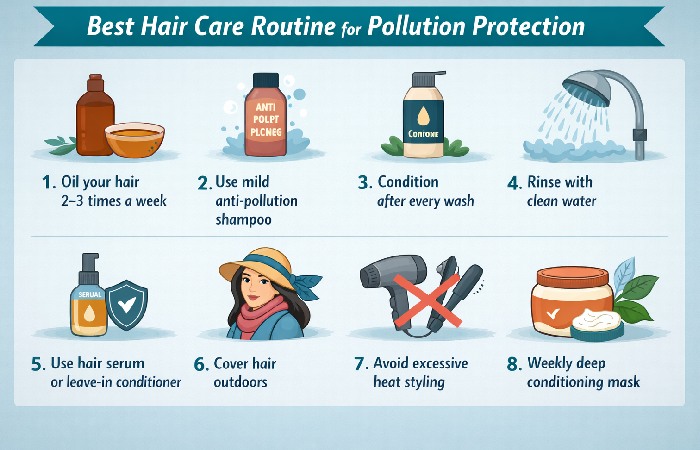
A consistent hair care routine is important for protecting your hair from dust, smoke, and other harmful air pollutants. Pollution can weaken hair roots, cause dryness, and lead to hair fall, so maintaining a proper cleansing and nourishing routine helps keep your hair strong, clean, and healthy. Using protective products and minimizing exposure also plays a key role in long-term hair health.
| Step | Routine Action | Benefit |
| 1 | Oil your hair before stepping out | Creates a protective layer against dust and pollution |
| 2 | Cover hair with a scarf/hat outdoors | Reduces direct exposure to pollutants |
| 3 | Use mild anti-pollution shampoo | Gently removes dirt, smoke, and buildup |
| 4 | Wash hair 2–3 times a week | Keeps scalp clean without over-drying |
| 5 | Apply conditioner after every wash | Restores moisture and softness |
| 6 | Use hair serum or leave-in spray | Shields hair from environmental damage |
| 7 | Avoid excessive heat styling | Prevents additional dryness and breakage |
| 8 | Do weekly deep conditioning | Repairs and strengthens damaged hair |
| 9 | Rinse hair after heavy pollution exposure | Removes fine dust particles from the scalp |
| 10 | Maintain a healthy diet & hydration | Supports strong hair growth from within |
How To Avoid The Effects Of Pollution Damage Hair?
The effects of pollution on hair are reversible and can be avoided if a proper routine is followed.
- Wash Hair Properly
- Proper Shampooing Is Essential To Prevent Or Combat The Effects Of Pollution.
- Use Special Shampoos
Using specific products to eliminate pollution residues is also one of the things that we must take into account to combat the effects of pollution. With them, we achieve a deeper cleaning without damaging the hair fiber.
How Air Pollution Affects Hair Health
Air pollution contains harmful particles, such as dust, smoke, and toxic gases, that settle on the scalp and hair strands. These pollutants clog hair follicles, weaken hair roots, and reduce oxygen supply to the scalp, leading to increased hair fall and slower growth. Over time, exposure to polluted air strips away natural oils, making hair dry, brittle, and prone to breakage.
| Effect | How It Happens |
| Hair Fall | Pollutants weaken hair roots and clog follicles |
| Dryness & Brittleness | Natural oils are stripped away by dust and smoke. |
| Scalp Irritation | Toxic particles cause itching and redness. |
| Dandruff | Pollution disrupts scalp balance, leading to flaking. |
| Dull Hair | Loss of moisture reduces shine and smoothness. |
| Slow Hair Growth | Blocked follicles reduce healthy hair production. |
| Breakage | Weak strands become prone to splitting and damage. |
| Follicle Clogging | Dirt and toxins clog scalp pores. |
Sensitivity Of The Scalp – Pollution Damage Hair
When pollutant particles come into contact with the scalp, they can sensitize and even irritate it. It makes the hair lose its natural shine and feel rougher.
Dryness – Pollution Damage Hair
Another effect that occurs when the hair is affected by pollution is that it becomes drier and does not look healthy.
Deterioration Of The Cuticle
When the pollutant particles floating in the environment come into contact with the cuticle, they change its structure. The most visible effect is frizz and hair breakage, mainly at the ends.
Fat Gain
When pollution affects oily hair, the sebum on the scalp increases while the ends dry out, with that in mind, we may be forced to increase washing frequency to keep grease at bay.
Anti-Pollution Hair Care Tips for Daily Protection
Daily exposure to pollution can weaken your hair, but a simple care routine can help protect it from damage. By following consistent habits, you can reduce hair fall, dryness, and scalp buildup caused by dust and harmful particles in the air.
Oil your hair lightly before going outside to create a protective barrier
Use a mild anti-pollution or sulfate-free shampoo regularly
Keep your hair covered with a scarf, cap, or hat outdoors
Avoid touching your hair frequently to reduce dirt transfer
Apply a light hair serum to protect strands from dust and smoke
Wash hair 2–3 times a week to remove pollutant buildup
Rinse hair with clean, lukewarm water after exposure to heavy pollution
Maintain a healthy diet rich in vitamins for stronger hair roots
Avoid excessive use of heat styling tools
Keep your scalp clean and well-moisturized.
Other Countries’ Treatment Prices for Pollution-Affected Hair
| Country/Region | Typical Treatment | Approx. Price Range |
| India | Hair regrowth/scalp therapy (PRP, QR678, laser) | ₹4,500 – ₹65,000+ per session (varies by treatment) |
| India | Hair and scalp treatment (clinic packages) | ~₹30,000 – ₹1,60,000+ (USD 350–2000 approx.) |
| USA | Advanced hair loss/restoration procedures (e.g., transplant) | ~$4,000 – $15,000+ (approx. ₹3,20,000 – ₹12,00,000+) |
| UK | Hair restoration/transplant | ~£3,000 – £10,000 (approx. ₹3,00,000 – ₹10,00,000+) |
| South Korea | Hair spa/scalp therapy (salon treatments) | ₩30,000 – ₩300,000+ (approx. ₹1,800 – ₹18,000+) |
Treatments to Restore Damaged and Dry Hair

Damaged, dry hair from pollution, heat styling, or chemical exposure can be restored with proper care and nourishing treatments. Regular hydration, deep conditioning, and strengthening therapies help repair hair strands, restore moisture balance, and restore natural shine and softness. Consistent care is key to reversing damage and preventing further breakage.
Use deep conditioning hair masks once or twice a week to restore moisture
Apply natural oils like coconut, argan, or almond oil for nourishment
Choose sulfate-free and moisturizing shampoos to prevent dryness
Try protein treatments to strengthen weak and brittle strands
Use leave-in conditioners or hair serums for daily hydration
Avoid excessive heat styling, such as straighteners and blow dryers
Trim split ends regularly to prevent further damage
Drink plenty of water and maintain a nutrient-rich diet for healthy hair
Use aloe vera or natural DIY masks for soothing scalp repair
Protect hair from pollution and sun exposure with coverings or scarves
Hair Loss: Contamination Or Alopecia?
The truth is that pollution by itself does not cause alopecia. However, it can alter hair growth or, in some instances, contribute to worsening telogen effluvium previously caused by other factors. When faced with unusual hair loss, it is essential to consult a team of medical experts in the field of hair, who can pinpoint the origin of this hair loss and thus recommend the most effective treatment in each case.
| Aspect | Hair Loss Due to Contamination (Pollution/Dirt/Products) | Alopecia (Medical Condition) |
| Definition | Temporary hair shedding caused by dust, pollution, sweat, or product buildup. | Chronic hair loss caused by immune, genetic, or hormonal factors |
| Main Cause | Environmental pollution, poor scalp hygiene, and excessive styling products | Autoimmune response, genetics, stress, and hormonal imbalance |
| Pattern of Hair Loss | Diffuse thinning, mostly temporary | Patchy bald spots or patterned hair loss |
| Scalp Condition | Oily, itchy, dandruff, clogged follicles | It may look normal or inflamed, depending on the type |
| Severity | Mild to moderate | Moderate to severe, can be progressive |
| Reversibility | Usually reversible with proper care | May be reversible or permanent, depending on the type |
| Treatment | Scalp cleansing, anti-pollution shampoos, detox treatments | Medical treatments like minoxidil, corticosteroids, and therapy |
| Time Frame | Short-term issue | Long-term or chronic condition |
| Diagnosis | Based on lifestyle and scalp condition | Requires a dermatologist’s diagnosis |
How Can We Protect Our Hair From It?
Our scalp and especially our hair are the first to come into contact with pollution. For this, you would take the spotlessness and hygiene of the scalp and hair care very extreme. Of course, a healthy and composed diet also plays a vital role.
However, other medicinal solutions, such as hyaluronic acid, must be considered when it originates to curbing or even retreating the effects of pollution on our hair. It is excellent hair protection; the follicles become more resistant and fall out less because they are moistened. Hyaluronic acid is an essential part of hair mesotherapy.
Now you have the answer and solution to the question, “Does pollution cause hair loss?”. All hair treatments and, most importantly, we have the trust of our customers. You can read about this from our reviews of hair transplants in Turkey. If you have questions about your hair loss problem, remember we have a free, no-obligation discussion service. Feel free to take benefit of it.
Conclusion
Our skin and hair are the first barriers our body has against pollution. Air pollutant particles and polycyclic aromatic hydrocarbons (PAHs) are generated by combusting fossil fuels such as coal, oil, organic matter, etc. and asphalt cause damage and irritation from oxidative stress due to the increase in oxygen free radicals.
