
Best Yoga Exercise – If there is one sport discipline that allows you to work on your physical condition, breathing, and mind, it is yoga! Indeed, between the joints, the abdominals and the alignment, yoga is the ideal ground to flourish and put the whole body to work. Because yes, yoga also allows you to surpass yourself, to go after what you thought you were capable of.
And on the front line: stretching and flexibility! Indeed, yoga’s asanas (postures) allow you to stretch gently and relax properly, whether you are a beginner or not, over the sessions. Who has never dreamed of being able to multiply the capacities of their body? It is possible thanks to gular yoga practice and knowing how to listen to your body. Does it interest you? Here is our selection of ten ideal postures to develop your flexibility!
Best Yoga Exercises for Daily Routine
| Yoga Exercise | Focus Area | Benefits | Duration / Reps | Difficulty Level | Key Tip |
| Sun Greeting (Surya Namaskar) | Full body | Boosts energy, warms up muscles | 5–10 rounds | Beginner–Intermediate | Flow smoothly, harmonize breath |
| Cat-Cow Pose | Spine, core | Improves flexibility, relieves tension | 8–10 cycles | Beginner | Move slowly with breath |
| Downward Dog | Arms, shoulders, legs | Increases the upper body, stretches the hamstrings | 30–60 seconds | Beginner | Keep heels toward the floor, spine long |
| Warrior II (Virabhadrasana II) | Legs, hips | Strengthens legs, increases balance | 30–45 seconds per side | Beginner | Anterior knee above ankle |
| Tree Pose | Balance, core | Increases stability, improves legs | 30–60 seconds per side | Beginner | Focus gaze on a fixed point |
| Bridge Pose | Glutes, lower back | Strengthens the posterior chain | 30–60 seconds | Beginner | Press evenly throughout the feet and shoulders |
| Boat Pose (Navasana) | Core, hip flexors | Builds abdominal strength | 20–40 seconds | Intermediate | Keep spine straight, chest lifted |
| Child’s Pose | Relaxation, spine | Reduces stress, stretches back | 1–2 minutes | Beginner | Breathe deeply, relax your shoulders |
| Seated Advanced Bend (Paschimottanasana) | Hamstrings, spine | Stretches back & legs, calms mind | 30–60 seconds | Beginner | Keep spine plain, fold from the hips |
| Corpse Pose (Savasana) | Mind, relaxation | Give back body, reduces stress | 5–10 minutes | Beginner | Breathe naturally, fully relax |
The Few Yoga Exercises That Can Improve Flexibility
These are quite a few yoga exercises that can improve flexibility and attentiveness. It is important to choose activities that are suitable for your level of fitness and experience. You should also listen to your body and avoid being too forceful of yourself. If you are new to yoga, starting with an introductory class is a good idea.
It will help you learn the essentials of yoga and how to do the poses carefully. You can also find many yoga videos and classes online. With even exercise, you will see a difference in your flexibility and attentiveness. Yoga can be a great way to improve your overall health and happiness.
The Cobra – Do Yoga And Become More Flexible
Among the most emblematic postures of yoga, the cobra is a must! Indeed, this position improves breathing and relaxes the whole body. This way, tensions will be better evacuated, and well-being will be the key! How to make it? It is straightforward! All you have to do is position yourself on a mat lying on your stomach. Place the palms of your hands alongside your body. Then, lean on your forearms, so your chest is lifted, not your pelvis. Pull the shoulders back, and here you are in the cobra position! Hold for about 30 seconds before repeating the pose. You can integrate it into a sun salutation or a more advanced sequence. The fact is that the cobra is a good base for working on flexibility while taking possession of your body. Notice to most beginners this asana is for you!
The Seated Gripper In Yoga – Best Yoga Exercise
The seated clamp seems not very complicated to set up, but it requires understanding that not everyone starts with the same flexibility. It is good because it will allow you to set goals, to improve yourself. From its real name, “Paschimottanasana”, the sitting clamp consists, in the starting position, of sitting on the ground (on a mat, for more comfort!) with your legs stretched out. But that’s not all, of course! Then, the challenge is to reach his feet with his hands and maintain the position for between one and three minutes.
The Candle – Best Yoga Exercise Posture For Flexibility
The candle is a semi-inverted posture, making it possible to make the spine more toned and soften the back and the legs. You are probably familiar with this movement since it has been famous since our earliest childhood. Beyond flexibility, it is claimed to have revitalizing and good qualities for specific organs, in particular, because of its inverted movement. Concretely, this is to lie on the ground, legs and arms stretched. Bend your knees, bringing them close to the buttocks.
Then, lift the pelvis and put your hands on your pelvis to hold it. Stretch your legs towards the sky, and keep your gaze on your feet to avoid hurting yourself. Keep the posture while listening to yourself, the time of about ten breaths. Finally, to return to the initial position, go gently, bending your knees towards your face, always supporting yourself with your hands. And voila! The candle has the main advantage of being fun while effectively working on flexibility. For long-term effects!
The Butterfly
The butterfly is a posture that stimulates both the hips and the thighs. It is essential here to keep your back straight. On the program: elasticity and flexibility! It involves sitting with your legs stretched out and bringing your feet inwards, as if to get into the lotus position. But before you do that, bring the soles of your feet together, lowering your knees as much as possible.
The Dog Upside Down – Best Yoga Exercise To Be Flexible

Among the most famous La Rochelle yoga postures the downward-facing dog poses as a base! The main interest is to be able to develop both strength and flexibility. In short, the body in its entirety! Make sure your shoulders are well above your wrists, and your buttocks are level with your knees on all fours. Then, push your pelvis skyward, forming a kind of inverted “V” with the body. It is how your limbs can be used and become more flexible for a few breaths. The tension in the neck is released, the spine stretches, and the body becomes more adaptable to follow other asanas simply!
Upward Facing Dog – A Stretching Posture Of Yoga
In the same perspective, the dog head up is a yogic base! While it could be confused with the cobra (rightly!), this exercise is based on the same principle and allows you to stretch the upper and lower back, provided you stand straight, especially at the neck level. Unlike the cobra, the dog head up also allows the strength of the limbs and therefore guarantees to soften the wrists and ankles. Straighten your legs, and lift your chest with the help of your forearms at the moment of inspiration. Then, and this is where everything changes, lift the pelvis as well, as well as the legs. Only your toes touch the ground. More difficult to achieve than the cobra, the dog head up allows, despite everything, unparalleled flexibility of the whole body, from the hamstrings to the shoulders through the column.
The Cow’s Head – Becoming Flexible By Doing Yoga
With its strange name to say the least, and its movements, which seem to be just as weird, the posture of the cow’s head is a perfect asana to become more flexible, especially for the shoulders. From its real name, “Gomukhâsana,” it also allows you to stretch the knees, hips, and bust. The cow’s head is used in some ways to practice parallel meditation. In a seated position, put yourself in the lotus position, if possible for you. You can use accessories to help you achieve this. Then, raise the hand opposite the highest knee and bend it over your back. Bend the other hand back as well, just below the shoulder. Join the two behind your back, the chest open, the right still straight. Guaranteed sensations and flexibility too!
The Pigeon In Yoga, Relaxes On The Ground
If you want to make your hips more flexible over time, the pigeon pose is an ideal yoga posture! In addition, it stretches the whole body, not just the spine. Once again, it may look like a cobra, except for a few details that make all the difference!
In an all-fours position, place your hands at shoulder level, and bring your left knee forward. Place your shin diagonally. Then, put your right leg back, thigh glued to the yoga mat. Sit on it, and above all: breathe regularly. It is how flexibility will be best relieved during exercise. Reverse your legs after about twenty seconds, and don’t forget: it’s essential to listen to yourself and not force yourself!
The Tree – Best Yoga Exercise
Particularly accessible to those who consider themselves more “stiff,” the tree pose is the ideal movement to link body and mind. Because yes, it is also a question of balance since it is necessary to stand on one leg. Yes, this posture is set up first standing, legs parallel. Fix a point to look in front of you. Then, put all the weight of your body on the left foot, pivoting the right foot slightly. Raise the latter, clasping your hands in a salute. Hold the position while breathing correctly; over the weeks, the spine will become more flexible and the hips more receptive.
Best Yoga Exercises to Build Strength
| Yoga Exercise | Main Muscles Directed | Strength Benefits | Difficulty Level | Key Tip |
| Plank Pose | Core, shoulders, arms | Builds total core and upper body force | Beginner–Intermediate | Keep the body in a direct line |
| Chaturanga Dandasana | Arms, chest, core | Enhances arm and shoulder power | Intermediate | Lower slowly with control |
| Warrior II Pose | Legs, glutes, core | Improves the second joint and the hips | Beginner | Keep the front knee unified |
| Chair Pose | Quads, glutes, back | Builds lower-body strength | Beginner | Sit back like in a chair |
| Boat Pose | Core, hip flexors | Strong intestinal builder | Intermediate | Keep spine straight |
| Downward Dog | Arms, bears, legs | Develops upper body steadiness | Beginner | Press heels toward the floor |
| Side Plank | Core, arms, obliques | Builds side core strength | Intermediate | Stack feet or sway |
| Bridge Pose | Glutes, confines | Upgrades the following chain | Beginner | Lift hips evenly |
| Crow Pose | Arms, wrists, core | Builds arm balance strength | Advanced | Engage the core tightly |
| Dolphin Pose | Shoulders, core | Strengthens the carrying safely | Intermediate | Keep forearms supported |
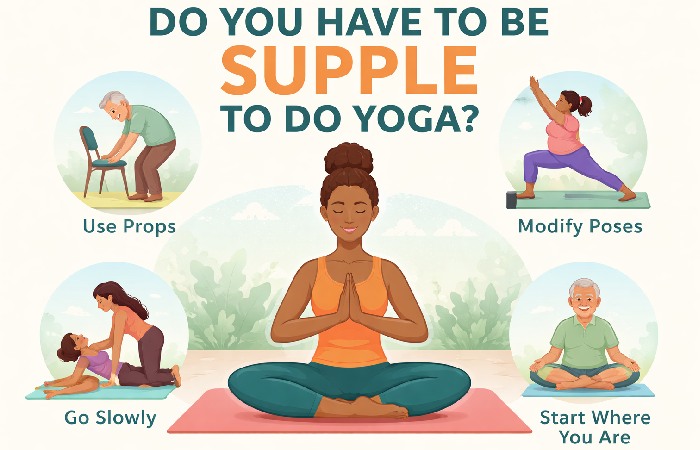
Do You Have To Be Supple To Do Yoga?
It is vital to know how to discriminate yoga from the exercise of Pilates or the gym. Indeed, yogic practice through asanas (postures) allows you to develop a certain letting go and serenity. Yes, but some people may see this discipline as a sporting issue.
With this in mind, one may wonder if it is necessary to be flexible to do yoga. The answer is no, but beware, some essential things are to know. First, it is imperative to understand that flexibility is not an end in itself and does not allow you to “better” enjoy the benefits of yoga.
However, it seems evident that it can impose itself as an additional ingredient to go further in specific movements and certain postures. And as flexibility is not a gift, it should be said that not everyone has the same dispositions when doing the seated clamp. And yoga is a sport that allows this, using specific asanas and adapting breathing to get there little by little.
12 Top Yoga Poses for Beginners
| Yoga Pose | Focus Area | Main Benefits | Difficulty Level | Key Tip |
| Mountain Pose (Tadasana) | Full body, posture | Improves posture, balance, and training | Beginner | Stand tall, engage thighs, extend spine |
| Downward Dog (Adho Mukha Svanasana) | Arms, carries, legs | Improves arms & legs, stretches hamstrings | Beginner | Press heels toward the floor, spine long |
| Cat-Cow Pose (Marjaryasana-Bitilasana) | Spine, core | Expands spinal flexibility, warms up the back | Beginner | Move with breath, rotate arch & round |
| Child’s Pose (Balasana) | Spine, reduction | Relieves stress, stretches the back | Beginner | Breathe deeply, relax your muscles |
| Warrior I (Virabhadrasana I) | Legs, hips | Improves legs, improves focus | Beginner | Keep fore knee above ankle, chest open |
| Warrior II (Virabhadrasana II) | Legs, hips | Improves legs, improves balance | Beginner | Expand arms, gaze over the front hand |
| Triangle Pose (Trikonasana) | Legs, spine, arms | Extends legs & spine, opens chest | Beginner | Keep chest open, hinge from the hip |
| Tree Pose (Vrikshasana) | Balance, legs | Enhances stability & focus | Beginner | Fix gaze, press foot touching the inner thigh |
| Bridge Pose (Setu Bandhasana) | Glutes, lower back | Increases glutes, stretches chest | Beginner | Lift hips evenly, press feet firmly |
| Cobra Pose (Bhujangasana) | Spine, chest | Strengthens the back, opens the chest | Beginner | Lift chest using back muscles, not arms |
| Seated Forward Bend (Paschimottanasana) | Hamstring tendon, spine | Stretches back & legs, calms mind | Beginner | Fold from the hips, keep the spine horizontal |
| Corpse Pose (Savasana) | Mind, reduction | Relaxes the body, reduces stress | Beginner | Lie still, breathe naturally, fully rest |
India, UK, USA, and London: Best Yoga Exercises
| Region | Typical Drop-In Yoga Class | Monthly Membership / Unlimited Classes | Notes |
| India | ₹300 – ₹2,000 per session (class) | ₹3,000 – ₹6,000/month for online unlimited | Budget studio to premium class range; private assemblies cost more |
| United Kingdom | £10 – £20 per class | £60 – £120/month | Drop-in cost varies with city and studio style; suites are offered |
| London | £10 – £25+ per session | £60 – £150/month | Middle London often costs more; specialty classes can exceed these scales |
| United States | $15 – $25 per class | $100 – $180/month | Urban workspaces are typically at the developed end; gym, yoga, or village yoga may cost less. |
Can I Lose Belly Fat by Yoga?
Yes, you can reduce belly fat with yoga, but it’s important to know how it works. Yoga alone doesn’t strangely melt fat in one spot — fat loss occurs overall in the body. However, yoga can help you tone your core, boost metabolism, reduce tension, and improve digestion, all of which can lead to reduced belly fat over time. Here’s how yoga helps with belly fat:
1. Improves Core Muscles
- Poses like Boat Pose (Navasana), Plank Pose, and Side Board target your abdominal muscles.
- A clearer core helps improve posture and gives the belly a more compact appearance.
2. Boosts Metabolism & Burns Calories
- Flowing series like Sun Salutations (Surya Namaskar) and Vinyasa yoga improve heart rate and burn calories.
- Regular practice can help with overall fat loss, comprising around the belly.
3. Decreases Stress
- High stress → increased cortisol, a hormone linked to belly fat.
- Relaxing poses like Child’s Pose, Corpse Pose (Savasana), and forward bends help decrease stress.
4. Improves Digestion
- Twisted poses like Seated Spinal Twist rouse the digestive organs and might help reduce bloating.
5. Promotes a Healthy Lifestyle
- Yoga supports mindful eating, better sleep, and balanced patterns, all of which support belly fat loss.
Conclusion
Yoga is one of the forms of exercise to stay fit and focused. Having its roots purely in India, it is mainly a traditional practice. It is growing in popularity worldwide with its significant health benefits. And indeed, knowing how to breathe well is essential to relieving specific movements and better understanding our body’s challenges. Because in the end, flexibility in yoga is also and above all: knowing how to listen to yourself.
